
Medical practice today is more complicated than it was even five years ago. Between staffing shortages, rising payroll costs, HIPAA compliance pressure, and constant insurance changes, operational decisions carry more weight than ever.
One of the biggest decisions practice owners face is this:
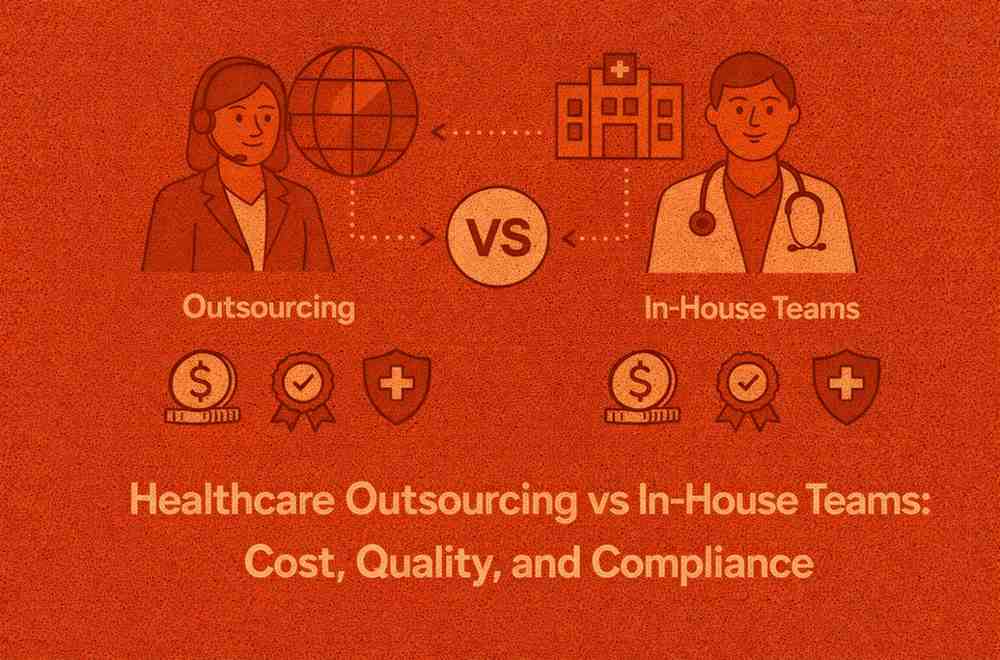
Should we build a full in-house team, or should we consider healthcare outsourcing? The answer depends on cost, quality expectations, and compliance readiness. Let’s break this down clearly and realistically.
Understanding In-House Healthcare Teams
An in-house team means hiring employees directly for roles such as front desk receptionists, medical billers, revenue cycle specialists, referral coordinators, and call center staff.
At first glance, this seems like the safer option. You can see your team. You train them personally. They become part of your office culture.
However, the true cost of hiring in-house medical staff goes beyond salary. You are responsible for recruitment, onboarding, benefits, payroll taxes, paid leave, training, supervision, and retention. When someone resigns — and healthcare turnover is high — the process starts all over again.
During gaps in staffing, productivity drops. Claims sit longer. Calls go unanswered. Existing employees feel stretched.
So while in-house staffing provides control, it also creates dependency and financial pressure.
What Is Healthcare Outsourcing?
Healthcare outsourcing means partnering with a company that provides trained remote professionals for your medical practice. This can include outsourced medical billing, remote front desk support, eligibility verification specialists, denial management teams, and healthcare call center services.
Instead of hiring internally, you work with a structured team that already understands medical workflows and compliance requirements.
For many small and mid-sized practices, outsourcing medical office staff has become a strategic solution rather than just a cost-saving tactic.
Cost Comparison: In-House vs Healthcare Outsourcing
When comparing healthcare outsourcing vs in-house teams, cost is usually the first concern.
Hiring internally includes:
- Base salary
- Benefits and insurance
- Payroll taxes
- Office space and equipment
- Software access
- Ongoing training
- Recruitment and turnover costs
These expenses add up quickly. Replacing just one employee can cost a significant percentage of their annual salary.
In contrast, the cost of outsourcing healthcare services is typically structured as a predictable monthly investment. There are no employee benefits to manage, no hiring fees, and no additional office overhead.
Many practices report noticeable reductions in staffing costs after shifting certain functions like medical billing or front desk operations to outsourced healthcare staffing solutions.
For growing clinics trying to control operational expenses, this difference can be substantial.
Quality of Service: Does Outsourcing Affect Performance?
A common concern is whether outsourced healthcare staffing lowers quality. In reality, quality depends on systems and training — not whether someone sits inside your office.
An in-house employee may be dedicated but often handles multiple responsibilities at once. Front desk staff frequently juggle calls, patient check-ins, insurance verification, and scheduling all at the same time. Mistakes can happen simply due to workload pressure.
Outsourced healthcare professionals typically focus on defined tasks. A remote revenue cycle specialist concentrates on claims and follow-ups. A virtual medical receptionist focuses on patient communication and scheduling.
That specialization often increases efficiency and consistency. Another overlooked factor is continuity. When an in-house staff member is absent, work slows down. With healthcare staffing outsourcing, structured backup support ensures workflows continue without disruption.
For many practices, this reliability improves overall service quality.
Compliance and HIPAA Considerations
Compliance is one of the most sensitive aspects of the outsourcing discussion. Many providers assume keeping operations in-house automatically ensures HIPAA compliance. However, compliance depends on processes, access controls, and staff training — not just physical location.
A well-structured healthcare outsourcing partner operates under strict HIPAA-compliant protocols. This includes secure access systems, encrypted communication, signed Business Associate Agreements, and documented compliance training.
In some cases, outsourced providers invest heavily in compliance infrastructure because healthcare data security is central to their business model. When evaluating healthcare outsourcing compliance risks, the focus should be on the partner’s standards and security framework rather than simply choosing in-house by default.
Properly managed outsourcing can meet — and sometimes exceed — internal compliance safeguards.
Scalability and Operational Flexibility
Healthcare practices rarely stay static. Patient volumes fluctuate. Services expand. New providers join the practice.
Scaling an in-house team requires time. Hiring, interviewing, onboarding, and training can take weeks or months.
Healthcare outsourcing offers flexibility. Additional support can often be added more quickly without long-term payroll commitments. Whether expanding call coverage hours or increasing revenue cycle management capacity, outsourcing allows practices to adjust without heavy structural changes.
For small clinics especially, healthcare outsourcing for small practices provides growth support without overwhelming financial risk.
Stability and Risk Management
One hidden challenge of in-house staffing is operational dependency. When a single employee owns a process — billing, scheduling, or referrals — your workflow depends entirely on that person’s availability. Unexpected absences can disrupt daily operations and delay revenue collection.
Outsourced healthcare staffing solutions typically include built-in redundancy. Work continues even if one individual is unavailable. This reduces operational vulnerability and protects consistency.
For practice owners who value stability and predictability, this can be a deciding factor.
Also Read: Healthcare Virtual Assistant
Choosing the Right Approach
Healthcare outsourcing vs in-house teams is not about replacing employees. It is about designing a structure that supports efficiency, cost control, and compliance.
Some larger healthcare systems prefer maintaining fully internal departments. However, many independent practices choose a blended model — keeping core leadership in-house while outsourcing medical billing, call center operations, or administrative support.
The goal is not simply reducing expenses. It is creating an operational model that supports long-term sustainability.
Final Thoughts
Healthcare staffing decisions directly impact your revenue cycle, patient experience, and regulatory compliance.
In-house teams offer direct oversight but come with higher overhead and dependency risks. Healthcare outsourcing provides cost predictability, scalability, and operational continuity when implemented with the right partner.
There is no one-size-fits-all answer. The best choice depends on your practice size, growth plans, and internal management capacity. What matters most is building a system that allows your providers to focus on patient care while your operational processes remain efficient, secure, and stable.
And in today’s healthcare environment, that balance is more important than ever.
Healthcare Outsourcing vs In-House FAQs:
Will outsourcing medical billing reduce the quality of work?
That’s a common worry. But honestly, quality depends more on the system than the location. A trained outsourced medical billing team that focuses only on revenue cycle management can sometimes be more consistent than one in-house staff member juggling phones, patients, and claims all at once. The key is choosing a provider with real healthcare experience.
Is outsourcing healthcare services safe from a HIPAA standpoint?
It can be if you work with a HIPAA-compliant partner. Any serious healthcare outsourcing company should sign a Business Associate Agreement and use secure systems for handling patient data. In-house teams can make mistakes too, so compliance really comes down to processes and training, not just where someone sits.
What are the downsides of outsourcing medical office staff?
The biggest risk is picking the wrong partner. If communication is poor or expectations aren’t clear, frustration can build up. That’s why it’s important to look for transparency, reporting systems, and healthcare-specific experience. When done thoughtfully, outsourcing usually runs smoothly — but like any partnership, it requires clarity on both sides.
Why are small medical practices turning to healthcare outsourcing?
Mainly because hiring has become harder. It’s time-consuming, and turnover is high. Many small clinics don’t have a full HR department to manage recruiting and retention. Outsourcing gives them access to trained professionals without adding long-term payroll pressure. It’s often about flexibility as much as cost.
Does outsourcing improve workflow in a medical practice?
It often does. When tasks like eligibility verification, appointment scheduling, or medical billing are handled by dedicated professionals, your internal team can focus more on patient care. That division of responsibility tends to make daily operations feel less chaotic and more structured.
Is it possible to keep some staff in-house and outsource the rest?
Yes, and many practices do exactly that. They keep certain roles internal, especially leadership or highly patient-facing positions and outsource areas like billing or call center support. A hybrid approach gives you control where you need it and flexibility where you want it.